
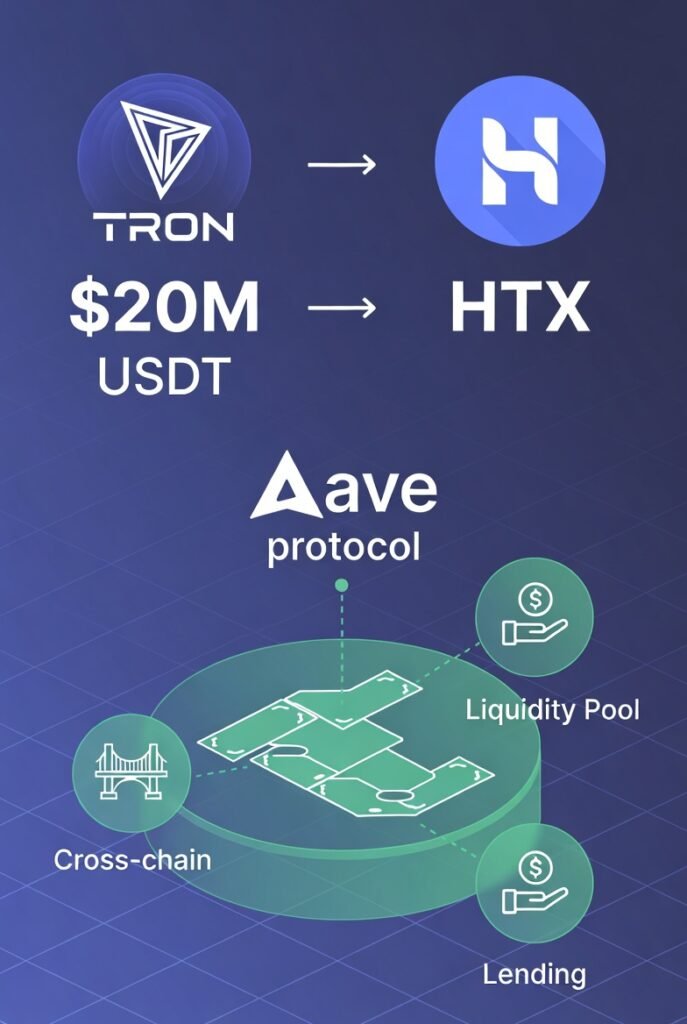
Imagine waking up to news that a major blockchain network and a top crypto exchange just poured $20 million in stablecoins into one of DeFi’s biggest lending platforms. No hype, no drama—just a calculated step that could quietly reshape how people lend, borrow, and earn in crypto. That’s exactly what happened when TRON and HTX teamed up to supply $20 million USDT to Aave’s Core V3 market.
This isn’t just another big transfer. It signals a fresh approach to building DeFi liquidity across different blockchains, especially as TRON pushes to bring Aave fully onto its fast and low-cost network.
What Actually Happened with the $20M USDT
On April 27, 2026, Justin Sun, founder of TRON, announced that TRON DAO and HTX jointly supplied 20 million USDT to Aave V3 on the TRON network. The move is framed as support to accelerate Aave’s integration onto TRON and strengthen overall DeFi liquidity.
Picture this: Aave is like a decentralized bank where anyone can lend or borrow crypto without paperwork. By adding substantial USDT (a stablecoin pegged to the US dollar), TRON and HTX are increasing the pool of money available for borrowers while giving lenders a chance to earn interest.
This supply is part of the broader “DeFi United” initiative, which aims to stabilize protocols and promote cross-chain collaboration after recent market stresses, including exploits like the one affecting Kelp DAO.
Why TRON and HTX Are Making This Move
TRON has grown into a powerhouse for stablecoins, with tens of billions in USDT circulating on its network thanks to ultra-low fees and fast transactions. HTX, the exchange closely tied to the ecosystem, brings additional liquidity and user access.
Supplying $20M USDT to Aave achieves several practical goals:
- Boosts liquidity on TRON — Users on TRON can now more easily lend or borrow against stablecoins without high gas fees.
- Supports Aave’s expansion — It encourages Aave to deepen its presence on TRON, making advanced DeFi tools available to a wider audience, especially in regions where low-cost transactions matter most.
- Strengthens cross-chain DeFi — The action highlights collaboration between a centralized exchange (HTX), a high-throughput blockchain (TRON), and a leading decentralized protocol (Aave).
In simple terms, it’s like adding more fuel to the engine so more people can drive smoothly. According to on-chain observers, this type of strategic liquidity provision helps tighten borrowing spreads and improves capital efficiency for everyday users.
How This Fits into a Bigger DeFi Strategy
DeFi has always struggled with fragmentation—different blockchains don’t always talk to each other well, and liquidity can dry up quickly during volatile times.
TRON’s approach here looks like a deliberate strategy:
- Leverage its strengths in stablecoin volume.
- Partner with established protocols like Aave instead of building everything from scratch.
- Use real capital (not just promises) to attract more users and developers.
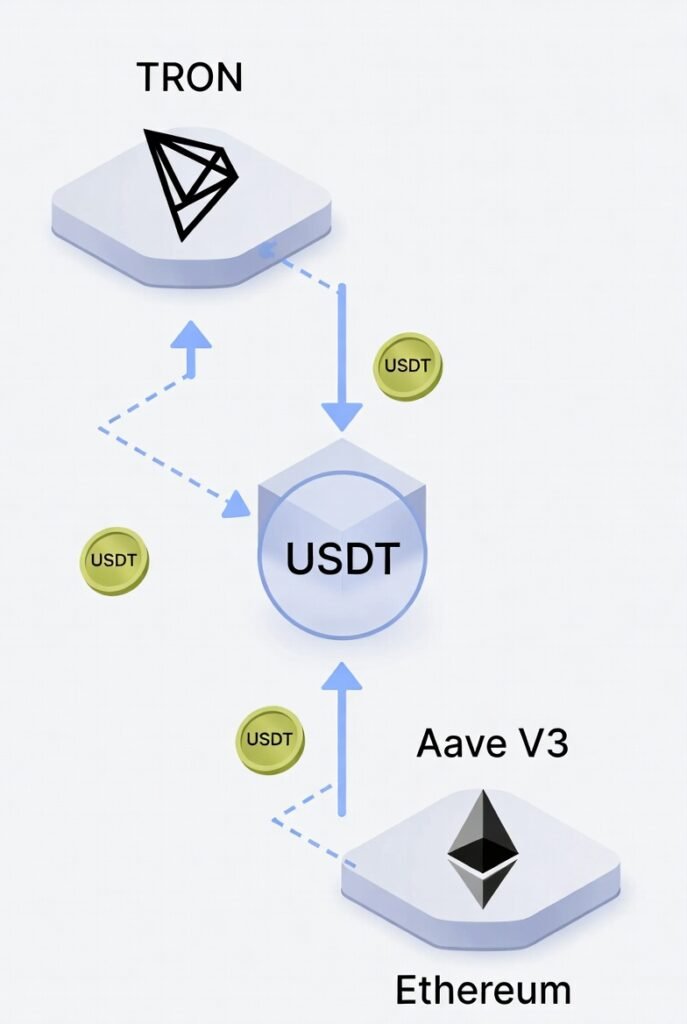
This mirrors how traditional finance grows: big players inject capital to create deeper markets. Here, the $20M acts as a signal of confidence, potentially drawing more liquidity from Ethereum or other chains toward TRON’s more efficient environment.
Experts note that such coordinated moves can enhance risk management and multi-asset lending options across ecosystems. It’s not about replacing one chain with another, but creating better connections so users aren’t locked into a single network.
Visualizing the impact:
What This Means for Regular Crypto Users
You don’t need to be a whale to care about this development. Here’s why it could matter to everyday participants:
- Lower costs — TRON’s low fees make small-scale lending and borrowing more practical compared to congested networks.
- More earning opportunities — Increased liquidity in Aave on TRON could lead to competitive interest rates for suppliers of USDT or other assets.
- Better borrowing access — Users holding TRX, other tokens, or stablecoins might find it easier to access loans without moving funds across expensive bridges.
- Ecosystem growth — Stronger DeFi on TRON could boost utility for TRX holders and attract new users from regions where affordability drives adoption.
Of course, all DeFi activities carry risks like smart contract vulnerabilities or market volatility. Always do your own research and never invest more than you can afford to lose.
Potential Impact on the Broader Crypto Landscape
This $20M move is the largest single commitment in recent Aave support efforts and comes alongside contributions from other players like Lido and Ether.fi (in ETH). It underscores a maturing DeFi sector where major stakeholders actively collaborate to maintain stability.
If Aave’s full integration on TRON succeeds, it could set a template for other protocols to expand efficiently. For TRON, it reinforces its position as a leading stablecoin hub while evolving beyond simple transfers into full-featured decentralized finance.
Longer term, strategies like this may help bridge the gap between centralized exchanges and pure DeFi, creating hybrid experiences that feel more accessible to newcomers.
Final Thoughts: A Smart Step Toward Mature DeFi?
TRON and HTX’s $20 million USDT supply to Aave isn’t flashy headline-grabbing drama—it’s quiet, strategic infrastructure building. By focusing on liquidity, collaboration, and user-friendly expansion, this move could help DeFi become more resilient and inclusive.
Whether you’re a seasoned DeFi user or just starting to explore crypto lending, developments like this highlight how the space is evolving from experimental to more structured and interconnected.
Keep an eye on how Aave performs on TRON in the coming months. The real test will be whether this injection sparks sustained activity and innovation on the network.
What do you think—will more protocols follow this cross-chain liquidity playbook? Share your thoughts in the comments.
References and further reading drawn from announcements by Justin Sun and reports from CoinEdition, BanklessTimes, and CryptoRank (April 2026). Always verify on-chain data and official channels for the latest updates.