
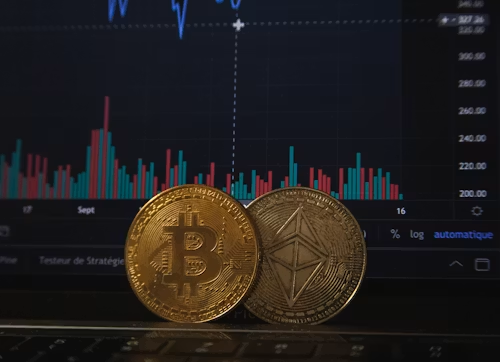
If you bought $1,000 of Bitcoin in January 2024 and $1,000 of Ethereum on the same day, by mid-2026 that 50/50 split has drifted — probably significantly. One asset outperformed the other, and your carefully planned allocation is now a mess.
This is the problem portfolio rebalancing solves. And in the volatile world of crypto, it is not just a nice-to-have — it is the difference between maintaining control of your risk and letting the market make decisions for you.

What Is Crypto Portfolio Rebalancing?
Rebalancing means periodically buying and selling assets within your portfolio to return to your target allocation. If you started with 60% BTC / 30% ETH / 10% altcoins and Bitcoin surged, your portfolio might now be 75% BTC / 18% ETH / 7% alts. Rebalancing sells some Bitcoin and buys the underperformers to restore your original ratios.
Without rebalancing, you are letting winners run — which sounds good — but you are also concentrating risk. A portfolio that is 80% Bitcoin is an all-in bet on one asset, not a diversified strategy.
Why Rebalancing Matters More in Crypto Than Stocks
Traditional finance portfolios drift a few percentage points per year. Crypto portfolios can double their allocation to one asset in a single week. The 2025-2026 bull run saw several altcoins gain 300-500% in under 60 days, completely destroying any pre-planned allocation.
The higher the volatility, the more frequently your portfolio needs attention. And crypto is the most volatile asset class on the planet.
The Three Most Common Rebalancing Strategies
1. Time-Based Rebalancing (Quarterly)
You rebalance on a fixed schedule — every month, quarter, or six months. For most retail investors, quarterly rebalancing strikes the best balance between maintaining discipline and avoiding excessive trading fees.
Pros: Simple, easy to automate, low mental overhead
Cons: Ignores extreme market moves between rebalance dates
2. Threshold-Based Rebalancing (5% Bands)
You only rebalance when an asset class drifts beyond a set threshold — typically 5% absolute deviation. For example, if Bitcoin was 50% of your portfolio but grows to 57%, you trigger a rebalance.
Pros: Captures volatility when it matters, fewer trades in calm markets
Cons: Requires monitoring, can trigger frequent trades during volatile weeks
3. Hybrid Method (Best for Most Investors)
Set a quarterly check-in with threshold bands as a trigger. If any asset is 5%+ off target at your quarterly review, rebalance. If everything is within range, skip it and check again in three months.
This method avoids both over-trading and under-trading. Major exchanges like Binance offer portfolio tracking tools that make this easy to monitor without spreadsheets.

How Often Should You Rebalance? The Data Says…
Backtesting studies on crypto portfolios show:
- Monthly rebalancing captures the most volatility benefits but generates 12-24 trades/year in trading fees
- Quarterly rebalancing captures ~85% of the benefit with 4-8 trades/year
- Annual rebalancing is too slow — portfolios can drift 20%+ before you act
- Daily rebalancing is pure waste for anyone managing under $100K
The sweet spot for most crypto investors: rebalance quarterly, or whenever an asset drifts 5% from target — whichever comes first.
Practical Example: Rebalancing a $10,000 Portfolio
Let us say your target allocation is:
- Bitcoin: 50% ($5,000)
- Ethereum: 30% ($3,000)
- SOL / MATIC / LINK: 15% ($1,500)
- Stablecoins (USDC): 5% ($500)
After a strong quarter, Bitcoin surged to $6,800 (68%) while ETH stayed flat at $2,800 (28%) and alts dropped to $400 (4%).
Your rebalancing move: sell $1,800 of BTC buy $200 of ETH and $1,600 of alts. Now you are back to 50/30/15/5.
The brilliant side effect: you just sold high (BTC) and bought low (alts) — exactly what disciplined investing is supposed to do.
Tax Implications of Rebalancing
Every sale in a rebalance is a taxable event (unless you are doing it inside a crypto IRA). In the US, assets held under 12 months are taxed as short-term capital gains (ordinary income rates). Long-term holdings (>12 months) get favorable treatment.
Tip: Use our crypto tax calculator to calculate the tax impact before executing a large rebalance. If tax exposure is high, consider adjusting your bands wider (e.g., 8-10%) to reduce trade frequency.
Tools to Automate Rebalancing
You do not need to manually calculate everything. Here are the best tools in 2026:
- CoinTracker / Koinly: Portfolio tracking with rebalancing alerts
- 3Commas / Bitsgap: Automated trading bots with rebalancing portfolios
- Binance Rebalancing Bots: Native portfolio rebalancing for spot wallets (requires API key setup)
- DeBank / Zapper: For DeFi portfolio tracking across multiple chains
For most readers, a simple spreadsheet plus quarterly manual rebalance is perfectly adequate until your portfolio exceeds $50,000.
What NOT to Do
- Do not rebalance weekly. Fees will eat your returns. A 0.1% per-trade fee on every weekly rebalance adds up to 5%+ annually.
- Do not rebalance emotionally. “I love ETH, I will keep 60% even though my plan says 30%” defeats the purpose.
- Do not chase performance. Rebalancing should return you to your plan, not shift toward the hot new coin.
- Do not forget stablecoins. Your USD/USDC allocation is your emergency fund and your “buy the dip” ammunition.
Final Takeaway: Discipline Beats Prediction
You cannot predict which crypto will outperform next quarter. Nobody can. What you can control is your allocation. Rebalancing forces you to buy low and sell high mechanically, removing emotion from the equation.
Start simple: pick a target allocation, set a quarterly calendar reminder, and follow the 5% band rule. Your future self — the one who did not panic-sell at the bottom — will thank you.
Ready to Build Your Crypto Portfolio?
Use our free Crypto Tools to calculate DCA amounts, estimate staking rewards, and check your airdrop eligibility — all with one click.
Do it in seconds: our free Portfolio Rebalancing Tool tells you exactly what to buy or sell to get back to your target allocation.
Disclaimer: Some links may be affiliate links. We may earn a commission at no extra cost. Full disclosure.Related reading: crypto portfolio tracker how to calculate pnl like a pro.

Written by Guru Tony
Guru Tony is a cryptocurrency analyst and educator with over seven years of hands-on experience in blockchain technology, DeFi, yield strategies and crypto tax. He builds the free calculators on this site and tests every strategy he writes about with his own capital. Read more about our editorial approach.