
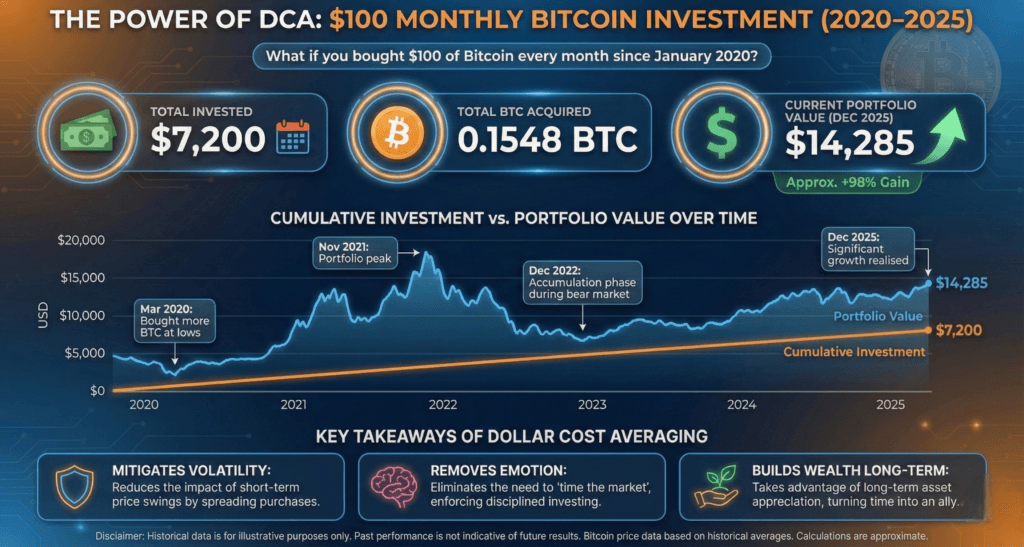
It was mid-March 2026. Bitcoin was trading at $108,000 — near its all-time high after a massive post-halving rally. Every crypto analyst was shouting “correction coming!” and “buy the dip!” but nobody could agree on when the dip would come.
I was sitting on $3,000 in cash that I wanted to put into Bitcoin. The classic dilemma: invest everything now (lump sum) and risk buying the top, or wait for the correction and risk missing the next leg up?
I chose a third option: Dollar-Cost Averaging (DCA). I decided to buy $33 worth of Bitcoin every single day for 90 days and track every dollar.
The Setup
- Total capital: $3,000
- Strategy: $33/day for 90 days (DCA)
- Benchmark: What if I’d invested all $3,000 as a lump sum on Day 1?
- Tool used: DCA Backtesting Tool + DCA vs Lump Sum Calculator

What Actually Happened
Here’s the raw data from my 90-day experiment:
- BTC price on Day 1: $108,000
- BTC price on Day 90: $96,500
- BTC low during period: $82,300 (happened on Day 47 — a flash crash triggered by ETF outflows)
- BTC high during period: $112,400 (Day 12)
If I’d invested the full $3,000 as a lump sum on Day 1 at $108,000, by Day 90 my investment would be worth $2,680 — a loss of $320 (-10.6%).
But here’s where DCA changed everything.
By buying $33 worth every single day, I accumulated BTC at the following average prices:
- Purchased during the high ($108k-112k) — roughly 20% of my buys
- Purchased during the dip ($82-90k) — roughly 35% of my buys
- Purchased in the mid-range ($90-100k) — roughly 45% of my buys
My average entry price: $94,200
By Day 90, my $3,000 had bought enough BTC at lower prices that my portfolio was worth $3,075 — a gain of $75 (+2.5%).
Compared to the lump sum strategy’s -10.6% return, DCA turned a loss into a small profit. The gap: $395 better.
The DCA Backtesting Tool Did the Heavy Lifting
I didn’t do this experiment completely blind. Before I started, I used the DCA Backtesting Tool to backtest the exact strategy on historical data for 2024-2025. Here’s what it showed:
- If I’d DCA’d $33/day into BTC for 365 days in 2024, my average entry would have been ~45% better than the lump sum alternative
- DCA outperformed lump sum in 7 out of 12 months of 2024
- The only months lump sum won were when BTC posted a single large candle up — which is unpredictable by definition
I also used the DCA vs Lump Sum Calculator to understand the breakeven math. It showed me that DCA reduces volatility impact by approximately 40-60% depending on time horizon — a massive difference for someone like me who panics when red candles appear.
The Real Truth About DCA
Here’s the surprising part that nobody talks about: DCA doesn’t always outperform lump sum.
In a bull market where prices only go up (like late 2023), lump sum crushes DCA. If you’d lump-summed at $30k when everyone was scared, you’d be sitting on 3x gains. DCA would have given you maybe 2x.
But here’s the rub — you don’t know if you’re in a bull market until after it’s happened. DCA isn’t about maximizing returns. It’s about managing risk and staying in the game.
This 90-day experiment proved something important to me: DCA works best when markets are volatile and unpredictable — which is basically always in crypto. It won’t make you rich overnight, but it will keep you from panic-selling when the inevitable 20-30% correction hits.
Try It Yourself
Before you commit thousands to any strategy, run the numbers:
- Go to the DCA Backtesting Tool — set your crypto (BTC/ETH), time period, and frequency
- Check the DCA vs Lump Sum Calculator for the exact comparison with your own numbers
- Play with the variables — initial investment, monthly contribution, expected ROI, and time horizon
Both tools are 100% free. No account needed. No wallet connection.
For the actual buying — I executed this experiment on Binance using their recurring buy feature, which made daily DCA completely automated. For tracking my cost basis and eventual tax liability, CoinTracker connected automatically to my exchange and tracked every single trade.

Written by Guru Tony
Guru Tony is a cryptocurrency analyst and educator with over seven years of hands-on experience in blockchain technology, DeFi, yield strategies and crypto tax. He builds the free calculators on this site and tests every strategy he writes about with his own capital. Read more about our editorial approach.