

Imagine spotting a price difference on the same future event across two platforms — one where the odds seem too low and another where they feel inflated. You act quickly, lock in a small guaranteed return no matter the outcome, and repeat it. This isn’t gambling; it’s prediction market arbitrage, and platforms like Outpoll are making it more accessible in 2026.
Prediction markets have exploded in popularity, with monthly trading volumes hitting over $20 billion. Yet many everyday people still view them as complex or risky. Outpoll stands out by offering tools designed for both beginners and active traders, turning potential inefficiencies into real opportunities.
What Are Prediction Markets and Why Do They Matter in 2026?
Prediction markets let people buy and sell shares in the outcomes of real-world events — elections, sports results, crypto prices, or even pop culture moments. A share might cost $0.45 if the crowd thinks there’s a 45% chance of something happening. If it does, the share pays $1; otherwise, it’s worth nothing.
These markets often prove more accurate than traditional polls because participants put real money on the line. In 2026, with global events unfolding rapidly, they’ve become go-to sources for insights cited by media and analysts alike.
Outpoll enters this space with a focus on usability and advanced features. It uses full collateralization in USDC, transparent resolution rules, and low fees around 0.1%. Unlike some platforms that feel clunky, Outpoll emphasizes professional-grade tools while staying approachable.
Understanding Arbitrage in Prediction Markets
Arbitrage simply means profiting from price differences without taking on directional risk. In prediction markets, this often happens because:
- Different platforms have varying liquidity and user bases.
- News hits one market faster than another.
- Temporary imbalances occur in YES/NO pricing.
For example, if YES shares for “Will Team A win?” trade at $0.58 on one site and the equivalent NO shares trade in a way that the combined cost is under $1 on another, you can buy both sides for a locked-in profit.
Academic research, such as studies on Polymarket data, confirms these opportunities exist, especially during volatile periods, though they require speed and precision.
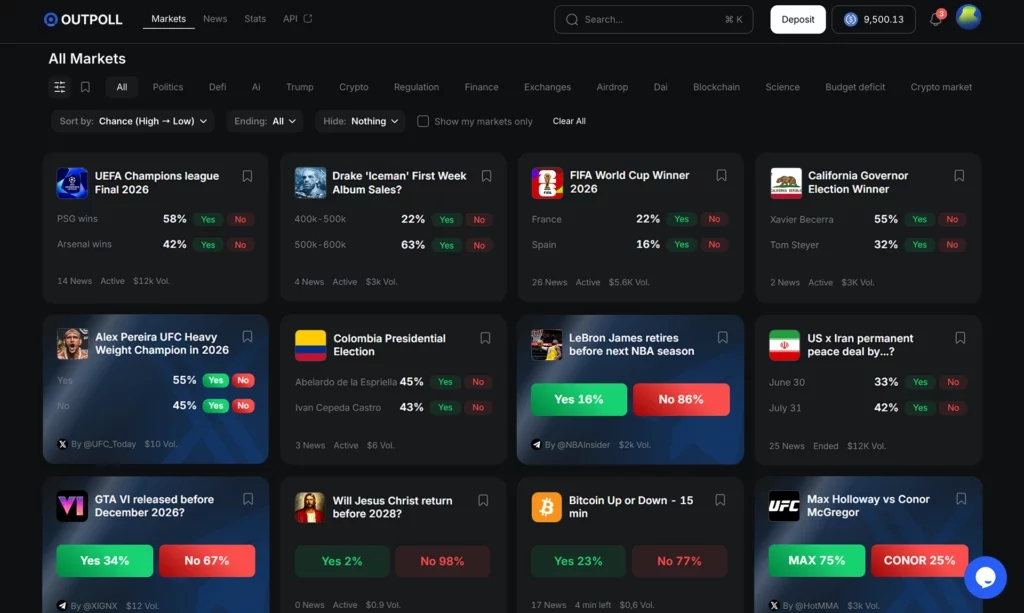
Outpoll Review 2026: Key Features That Support Arbitrage
Outpoll differentiates itself with trader-centric tools that make arbitrage more practical for non-experts.
Advanced Order Types You get limit orders, market orders, and crucially, take-profit and stop-loss. This helps manage positions if you’re holding across platforms while waiting for convergence.
Public API Access The REST and WebSocket APIs allow automation. Developers and even tech-savvy individuals can build simple scripts to scan for price differences across Outpoll and competitors like Polymarket or Kalshi. Python examples are readily available in their docs.
Creator-Led Markets Experts and communities launch niche markets, often creating temporary inefficiencies before broader awareness kicks in — prime ground for careful arbitrage.
Integrated News and Mobile App Stay informed without switching tabs, and trade on the go via the native Android app (iOS coming soon). Speed matters in arbitrage.
Outpoll feels built for active users who want an edge without needing a finance degree.
Step-by-Step: How to Profit from Prediction Market Arbitrage with Outpoll
Here’s a straightforward approach suitable for beginners:
- Choose Your Platforms Sign up on Outpoll and one or two others with good liquidity. Compare the same events.
- Spot the Opportunity Look for YES + NO prices summing to less than $1 (after fees) or identical outcomes priced differently. Tools and APIs help automate this scan.
- Execute the Trade Buy the undervalued side on one platform and the offsetting side on another. On Outpoll, use limit orders for better pricing.
- Monitor and Settle Hold until resolution. Use stop-loss if volatility spikes. Profits come from the spread.
- Scale Carefully Start small. Fees, withdrawal costs, and execution slippage can eat into tiny edges.
Real-world examples from 2025-2026 show bots and alert traders capturing consistent small gains during news-driven volatility.

Risks and Challenges to Watch Out For
No strategy is completely risk-free. Key pitfalls include:
- Settlement Differences: Wording variations between platforms can lead to unexpected outcomes.
- Liquidity and Fees: Thin markets or high costs can erase profits.
- Regulatory and Platform Risks: Rules vary by region.
- Execution Speed: Opportunities vanish quickly; manual trading has limits.
Studies highlight that while arbitrage exists, successful exploitation often favors those with automation. Always understand the resolution sources Outpoll publishes upfront.
Practical Tips for Everyday Traders
- Focus on high-volume events like major elections or sports for better liquidity.
- Use alerts and APIs rather than constant screen-watching.
- Track your trades in a simple spreadsheet to calculate net returns after fees.
- Combine with basic research — arbitrage is about prices, but context helps avoid bad markets.
- Start with paper trading or tiny positions to learn the flow.
Outpoll’s transparent rules and tools lower the barrier compared to purely decentralized options.
The Future of Arbitrage and Outpoll’s Role
As prediction markets mature toward $21B+ monthly volumes, inefficiencies will persist due to fragmented platforms and human (or bot) reactions. Outpoll’s emphasis on API accessibility and trader tools positions it well for users seeking sustainable edges.
Whether you’re a curious newcomer or someone looking to supplement income, understanding these mechanics opens doors. The key is discipline, continuous learning, and treating it like a skill rather than a get-rich-quick scheme.
Ready to explore? Head to Outpoll’s site and start with their demo or small markets. The world of probabilistic trading awaits — one careful trade at a time.
This article is for educational purposes only and does not constitute financial advice.