
Millions of Americans lose hard-earned money every year to invisible thieves operating from halfway around the world—fake investment schemes, romance frauds, tech support cons, and phishing attacks that empty bank accounts in minutes. In 2024, reported cyber-enabled fraud losses topped $12.5 billion, with many victims never recovering a dime. On March 6, 2026, President Donald J. Trump addressed this escalating crisis head-on by signing a new Executive Order and unveiling President Trump’s Cyber Strategy for America, a comprehensive plan aimed at dismantling scam networks, prosecuting offenders aggressively, and putting real money back into victims’ pockets.
This isn’t vague rhetoric; it’s a roadmap that treats cybercrime like the organized threat it is, vowing to make life much harder for the criminals who hide behind keyboards and fake websites.
Key Highlights of the New Executive Order
The Executive Order zeroes in on cyber fraud, predatory schemes, and transnational criminal organizations (TCOs) that run massive scam operations overseas. It instructs federal agencies to use every lever—law enforcement, sanctions, diplomacy, and technology—to disrupt these groups.
Main actions include:
- Developing a targeted action plan to identify and take down scam centers and cybercrime syndicates.
- Setting up a special operational cell within the National Coordination Center for faster, coordinated takedowns.
- Directing the Department of Justice to prioritize criminal prosecutions of fraudsters and scammers.
- Exploring creation of a Victims Restoration Program to return seized criminal proceeds directly to defrauded individuals.
The order also calls for stronger pressure on foreign governments that shelter these networks through sanctions, visa bans, and diplomatic consequences.
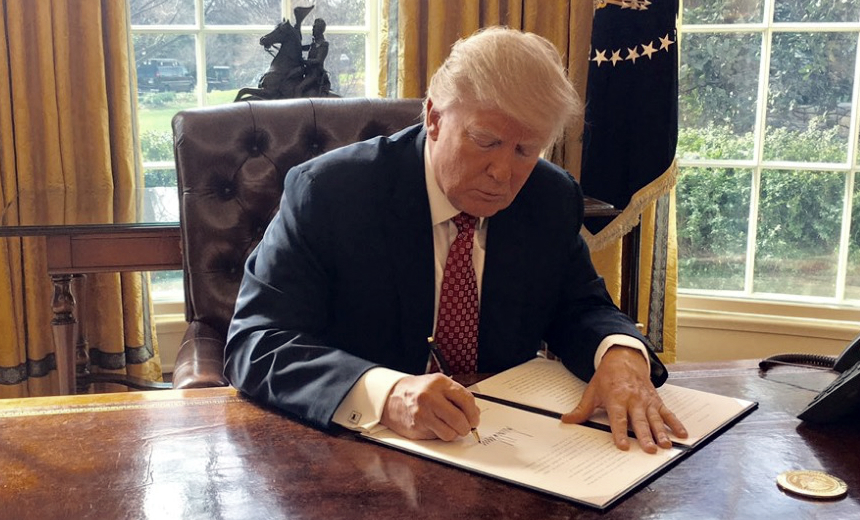
(These photos capture the moment of signing important executive actions in the Oval Office, symbolizing decisive government response to national security threats like cybercrime.)
Breaking Down President Trump’s Cyber Strategy for America
The accompanying Cyber Strategy for America outlines a six-pillar framework built on “America First” priorities. It commits to offensive and defensive cyber superiority, close collaboration with private companies, and slashing unnecessary regulations that slow down innovation and response times.
The document points to past successes—such as major operations that seized billions in stolen funds and crippled ransomware gangs—as proof that bold, coordinated disruption pays off. It promises to deny criminals safe financial channels, destroy their infrastructure, and impose lasting consequences on state and non-state actors who target U.S. citizens and companies.
While implementation details will follow in future action plans, the overall direction is unmistakable: shift from playing defense to actively raising the risks and costs for anyone attacking American interests in cyberspace.

(Infographics illustrating foundational pillars of national cybersecurity strategies, showing structured policy areas like defending infrastructure and disrupting threats.)
How This Directly Affects Ordinary People
For the average person, cybercrime feels personal: it’s the urgent call claiming your Social Security number is compromised, the email demanding immediate payment, or the dating app match who suddenly needs money for an “emergency.” This strategy targets those exact pain points by focusing on overseas scam factories and promising faster victim restitution.
Stronger protections for critical infrastructure—power plants, hospitals, payment systems—also reduce the chance that one big breach disrupts daily life for millions. The emphasis on returning seized funds to victims could mark a real change for people who’ve lost savings to fraud.
Past coordinated efforts have shown measurable success in reducing specific cyber threats, according to reports from leading cybersecurity research organizations.

(Illustrations of common cyber threats like phishing, ransomware, and malware, highlighting the digital dangers the new strategy aims to combat.)
Realistic Expectations and Next Steps
If carried out effectively, this plan could shrink the safe space for global cybercrime rings and give victims better chances at recovery. Streamlining rules for companies and modernizing federal systems should help everyone respond quicker to emerging dangers.
Challenges exist: full rollout across agencies takes coordination, international partners may resist, and attackers constantly adapt. Cyber risk never disappears completely, but this approach signals a more aggressive, victim-centered stance.
For the official sources:
- White House Fact Sheet on Combating Cybercrime (March 2026)
- Full PDF of President Trump’s Cyber Strategy for America
In the meantime, simple habits remain powerful: use unique strong passwords, turn on two-factor authentication everywhere possible, verify suspicious requests, and report scams promptly

(Everyday cybersecurity visuals showing two-factor authentication in action and basic protection icons, reminding readers of practical steps they can take right now.