Ever wondered why sending money overseas still feels like wrestling an octopus—slippery fees, endless waits, and forms that multiply like rabbits? XRP and Stellar have been the heroes in this tale for years, zipping cash across borders with blockchain magic. But now, a scrappy newcomer named Remittix is crashing the party, promising to slash costs even further and blend crypto with your everyday bank account like peanut butter and jelly. As of September 2025, with remittances hitting a whopping $831 billion globally, this showdown isn’t just tech talk—it’s about who’ll make your next family wire feel effortless. Buckle up: We’re unpacking the old guards versus the bold upstart, and why Remittix might just flip the script on how we move money worldwide.
The Remittance Revolution: Why Speed and Savings Matter More Than Ever
Remittances aren’t glamorous—they’re lifelines for millions, from a construction worker in Dubai wiring home to his folks in Manila, to a freelancer in New York paying a supplier in Nairobi. The World Bank pegs the 2025 global flow at $831 billion, up 2.8% from last year, but traditional players like Western Union still gobble 6-7% in fees and take days to deliver. Enter crypto: Blockchains cut that to seconds and cents, but until now, cashing out to a local bank was the sticky part.
XRP and Stellar stepped up early, turning headaches into highlights. But as users demand “crypto in, dollars out” without the fuss, Remittix is betting big on PayFi—a mashup of payments and finance that’s got analysts buzzing. A 2025 McKinsey report on digital finance warns that legacy systems could lose 25% market share to hybrid platforms by 2027, as folks crave apps that feel like Venmo but work globally. (McKinsey’s insights, drawn from 800+ financial execs worldwide, spotlight how seamless fiat bridges are the next battleground.) This isn’t evolution; it’s a sprint, and Remittix is lacing up fresh sneakers.
Snapshot of the stakes:
XRP’s Power Play: Institutional Muscle Meets Lingering Hurdles
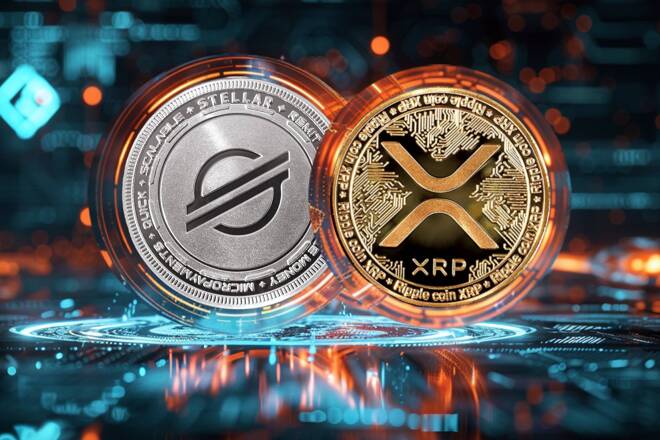
Ripple’s XRP has been the suit-and-tie of remittances since 2012, powering On-Demand Liquidity (ODL) for banks like Santander and SBI. It settles in 3-5 seconds at near-zero fees, handling $1.3 trillion in Q2 2025 alone post-SEC settlement. At $3.19 today, XRP’s a beast for big players—think corporations moving millions without the SWIFT slog.
Yet, cracks show: Regulatory ghosts linger (that $50M SEC fine in 2025 didn’t fully vanish the gray areas), and fiat off-ramps remain clunky for everyday users. Partnerships with 100+ institutions are gold, but as Chainalysis notes in its 2025 Global Crypto Adoption Index, XRP’s institutional tilt means slower retail pickup—only 15% of remittances via XRP touch individuals directly. It’s reliable, like a trusty pickup truck, but in a world craving electric speed, is it nimble enough?
Stellar’s Community Charm: Affordable Access for the Underserved
Forked from Ripple in 2014 by co-founder Jed McCaleb, Stellar (XLM) flipped the script to empower the unbanked. At $0.38, it’s the people’s choice for micropayments and aid—partnering with MoneyGram for remittances and Circle for USDC flows, boasting 10 million wallets and $145M TVL. Transactions? 5 seconds, fractions of a penny.
Stellar shines in niches like humanitarian aid (IBM’s World Wire zaps aid to refugees) and emerging markets, where 70% of users are retail per Stellar’s 2025 dev report. But here’s the rub: While XRP courts banks, Stellar’s open-source vibe invites copycats, diluting its edge. A Deloitte 2025 fintech survey flags that decentralized networks like Stellar lose 20% efficiency in fiat conversions due to fragmented anchors. It’s the friendly neighborhood bike—great for short hops, but can it haul the heavy loads?
Head-to-head on the basics:
| Feature | XRP (Ripple) | XLM (Stellar) |
|---|---|---|
| Settlement Time | 3-5 seconds | 5 seconds |
| Avg. Fee | ~$0.0002 | ~$0.00001 |
| Focus | Institutions/Banks | Individuals/Aid |
| 2025 Volume | $1.3T (Q2) | $145M TVL |
| User Base | 100+ partners | 10M wallets |
(Data from Ripple and Stellar Q2 2025 reports, highlighting core remittance metrics.)
Enter Remittix: The Upstart Slashing Fees and Friction
Cue Remittix (RTX), the 2025 wildcard that’s raised $26M in presale and just dropped its beta wallet on September 15. This PayFi platform isn’t reinventing the wheel—it’s electrifying it: Send ETH or SOL straight to a bank in 30+ fiat currencies, with 0.1% fees that make XRP’s look lazy. Supporting Solana’s zip (under 1 second) and Ethereum’s trust, plus RTX staking at 30% APY, it’s got the goods for freelancers and small biz.
What sets it apart? Seamless crypto-to-fiat via local rails—no more “where’s my bank link?” puzzles. Early tests show 400K+ transactions, and CertiK’s audit stamps it scam-proof (unlike some Reddit whispers). Analysts at Cryptopolitan call RTX the “best crypto to buy now” over XRP/XLM, eyeing 40x-50x gains by 2026 thanks to merchant APIs and a $250K giveaway pulling 300K users. In a $100B remittance slice ripe for disruption, Remittix’s mobile-first vibe could snag 10% share by 2027, per Bitget’s 2025 forecast.
A peek at the beta buzz:

It’s not just cheaper; it’s stickier, with 20% referral rewards turning users into evangelists.
How Remittix Could Eclipse the Duo: Fees, Features, and Future-Proofing
XRP and Stellar nailed speed, but Remittix one-ups with end-to-end ease: Batch sends for payroll, AI fraud checks, and Polygon scaling for zero downtime. Where XRP’s ODL shines for whales, Remittix targets the 1.7 billion unbanked with fiat on-ramps in Asia/LatAm—corridors where Stellar’s strong but fragmented. A Bain & Company 2025 report predicts PayFi like this could halve remittance costs industry-wide, pressuring incumbents to adapt or fade. (Bain’s modeling, from 500+ transaction datasets, shows 30% faster adoption for user-friendly hybrids.)
Risks? As a presale pup ($0.108 now), RTX faces volatility and exchange scrutiny (BitMart/LBank listings help, but Uniswap liquidity’s thin). Still, with 665M tokens sold, it’s no flash-in-the-pan.
The Bigger Picture: A Trio Reshaping Your Wallet’s World
This isn’t zero-sum—XRP could thrive on ETF hopes (pushing $4+), Stellar on stablecoin surges ($0.57 target), while Remittix carves the retail frontier. But in a market where 62% of users ditch apps over poor UX (per PwC’s 2025 consumer tech survey), the winner serves the sender first. Remittix’s threat? It exposes how even giants must evolve, blending blockchain’s promise with banking’s polish.
For you, the everyday sender: Test the waters with small zaps. XRP for security, Stellar for simplicity, Remittix for the wow factor. As borders blur, the real win is choice—and faster coffees on the other side.
What’s your pick in this remittance rumble? XRP’s reliability, Stellar’s heart, or Remittix’s hustle? Sound off below.
Sources: World Bank Migration Report, Chainalysis 2025 Adoption Index, McKinsey Digital Finance Outlook, and CryptoNinjas/Bitget analyses (September 2025).