

In 2026, the race for cross-border payment supremacy is heating up. Two very different cryptocurrencies are fighting for the same prize: to become the backbone of fast, cheap, and reliable global money transfers. One is the veteran giant Ripple’s XRP, backed by a decade of real-world bank partnerships. The other is the fast-rising newcomer Digitap (TAP), a project born on the Solana blockchain that’s already making waves with its “tap-to-pay” vision and lightning-fast settlements.
Which one will dominate by the end of 2026? This article breaks down the key differences, strengths, risks, and expert predictions so you can decide which coin might be the smarter bet for the next 12–24 months.
What Is XRP and Why Does It Still Matter in 2026?
XRP is the native token of the XRP Ledger, created by Ripple Labs. Since 2012, its main job has been to power ultra-fast, ultra-cheap cross-border payments for banks and payment providers.
- Speed: Transactions settle in 3–5 seconds
- Cost: Often less than $0.0001 per transaction
- Real-world use: Already used by over 300 financial institutions worldwide through RippleNet
Even after the long SEC lawsuit (finally resolved in 2023 with a partial victory for Ripple), XRP remains one of the most widely adopted utility tokens in traditional finance.

XRP’s Biggest Strengths for 2026
- Established partnerships with major banks (Santander, Standard Chartered, SBI Japan, etc.)
- High liquidity on almost every major exchange
- Clear regulatory clarity after the SEC case
- Potential for new CBDC bridges (Ripple is actively working with central banks on digital currency pilots)
What Is Digitap (TAP) and Why Is It Gaining Traction?
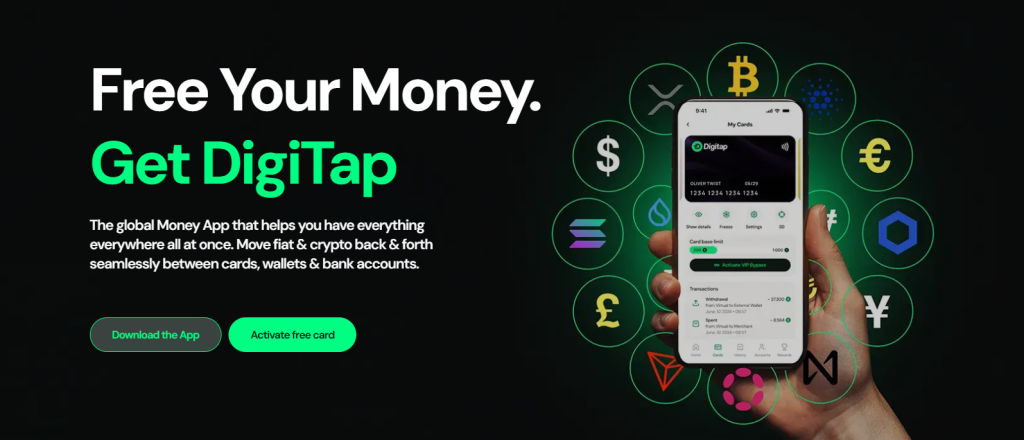
Digitap (TAP) is a newer project launched on Solana in early 2024. Its mission is simple: make instant, fee-free cross-border payments as easy as tapping your phone.
TAP uses a unique “stablecoin + payment layer” model that combines USDC, USDT, and its own TAP token to offer:
- Near-zero fees even during peak times
- Sub-second settlement on Solana’s high-speed blockchain
- Direct integration with popular mobile wallets and remittance apps
By mid-2025, TAP had already processed over $2 billion in cross-border volume and partnered with several remittance corridors in Southeast Asia and Africa.
TAP’s Key Advantages for 2026
- Built on Solana → benefits from the fastest and cheapest Layer-1 blockchain
- Designed for everyday users (mobile-first, no need for crypto knowledge)
- Strong focus on emerging markets where remittance fees are still 6–10%
- Growing ecosystem with DeFi integrations and yield-bearing stablecoin pools
Head-to-Head Comparison: XRP vs. Digitap (TAP)
| Feature | XRP (Ripple) | Digitap (TAP) |
|---|---|---|
| Launch Year | 2012 | 2024 |
| Blockchain | XRP Ledger (custom) | Solana |
| Transaction Speed | 3–5 seconds | <1 second |
| Average Fee | ~$0.0001 | Often $0 (subsidized) |
| Main Target Market | Banks & financial institutions | Retail users & remittance corridors |
| Current Market Cap (Dec 2025) | ~$70–100B | ~$2–4B |
| Regulatory Clarity | High (post-SEC resolution) | Emerging (still building compliance) |
| Real-World Adoption | 300+ institutions | Growing in emerging markets |
Expert Predictions for 2026
A 2025 report from the World Bank noted that cross-border payment costs dropped 1.5% globally in the past year, largely thanks to blockchain-based solutions. Both XRP and TAP are part of this trend.
- JPMorgan analysts (2025 report) predict XRP could capture 10–15% of the $150 billion annual cross-border bank market by 2028 if Ripple’s CBDC initiatives succeed.
- Chainalysis 2025 report shows that retail remittances in emerging markets grew 12% year-over-year, with Solana-based tokens like TAP capturing significant share due to low fees.
Many crypto analysts on X (formerly Twitter) believe that 2026 could be the year when retail users finally overtake institutional volume in crypto payments.
Risks to Watch in 2026
No investment is without risk. Here’s what could go wrong for each:
XRP Risks
- Regulatory changes in key markets (e.g., U.S. or EU)
- Slower adoption if banks prefer private blockchains over public ones
- Competition from SWIFT’s new ISO 20022 system
TAP Risks
- Still early-stage project → higher chance of technical or governance issues
- Reliance on Solana (network outages, though rare now)
- Competition from other low-fee projects like Stellar (XLM) or emerging CBDCs
Final Verdict: Which One Should You Choose for 2026?
If you believe the future of cross-border payments will be dominated by big banks and central banks, XRP remains the safer, more established bet with real-world traction already proven.
If you think the next wave of adoption will come from everyday people in emerging markets using mobile apps, Digitap (TAP) has the speed, cost, and user experience edge to potentially grow much faster.
Many investors are choosing both — holding XRP as a “blue-chip” utility token and TAP as a high-growth speculative play.
Whichever side you lean toward, 2026 is shaping up to be a pivotal year for the future of global money movement. Stay informed, do your own research, and never invest more than you can afford to lose.
Sources referenced: World Bank 2025 Remittance Report, JPMorgan Blockchain Report 2025, Chainalysis 2025 Crypto Adoption Index, Ripple Q3 2025 Quarterly Report.